
Happy Holidays from All of Us at Sage!
Here at Sage Science headquarters in Beverly, Mass., we’ve already got visions of sugarplums dancing in our heads — so what better time to look back on the past year?
We are happy to report that 2013 was a great year for us and our customers. There have been several terrific publications released this year from scientific teams using Pippin automated DNA size selection. Here’s a small selection of not-to-be-missed papers:
Cheng et al. “Semiconductor-based DNA sequencing of histone modification states.” Nature Communications.
Bronner et al. “Improved protocols for Illumina sequencing.” Current Protocols in Human Genetics.
Love et al. “Selective Inhibition of Tumor Oncogenes by Disruption of Super-Enhancers”
DuBose et al. “Use of microarray hybrid capture and next-generation sequencing to identify the anatomy of a transgene.” Nucleic Acids Research.
Park et al. “An improved approach to mate-paired library preparation for Illumina sequencing.” Methods in Next Generation Sequencing.
We were also lucky enough in 2013 to spend time hearing about some truly fascinating work that are customers have been doing. If you haven’t yet checked them out, grab some eggnog and enjoy these customer profiles:
At TGAC, Pippin-Aided Sequencing Gives Quality Boost to Genome Assemblies
At Iowa Core Lab, Pippin Sizing Is Essential for MicroRNA Studies
At MIT, Pippin Enables Splice Variant Detection and MicroRNA Analysis
Tag Team: At DFCI, Pippin and Nextera Make Better Libraries
At Boston University, Pippin Makes Quick Work of ChIP-seq Prep
The year also saw more vendors including Pippin products in their recommended protocols, including Illumina (Nextera mate pair sequencing), Ion Torrent (exome enrichment), and Pacific Biosciences (long-read sequencing). Indeed, BluePippin really came into its own this year, with customers reporting that they could significantly increase throughput and average read length from their PacBio sequencers by using BluePippin sizing.
Our R&D team kept busy as well. We launched new cassette kits extending the selection range for BluePippin, cassettes with smaller elution wells for customers who prefer 25 µl output, our Pippin Pulse power supply for analytical gels, and our cassette for Epicentre’s ScriptSeq kit that boosts library diversity.
No wonder we’re ready for a little time off! We’ll rest up over the holidays and come back fully recharged and ready to bring you more great products and terrific science in 2014.
Happy holidays, everybody!
At Boston University, Pippin Makes Quick Work of ChIP-seq Prep
At Boston University, the Galagan lab is trying to get a complete picture of Mycobacterium tuberculosis — in particular, how the organism’s regulatory network functions. By methodically performing ChIP-seq on each transcription factor in the microbe, the scientists are using sequence data to determine which other transcription factors and genomic regions are expressed as a result. The ultimate goal: a comprehensive view of the complex interactions among these transcription factors across the whole TB genome.
The scientist behind the lab’s library prep is Chris Mawhinney, who says that using Pippin Prep for size selection in the ChIP workflow saves her time and eliminates the possibility of sample cross-contamination. Mawhinney performs size selection after adapter ligation and purification as she preps libraries for sequencing on the Illumina GAIIx. “If you have too broad a range of sizes, the sequencer software has issues locating the clusters,” she says. “And adapter-dimers will anneal to your flow cell and eat up your reads, wasting capacity.”
Mawhinney uses Pippin to select for 250 base pairs, which allows her to remove the low molecular weight content as well as larger fragments. “With Pippin Prep, you can get it down to a really nice, narrow size,” she says, noting that the tool is easy to set up and run.
In addition to the time savings of using an automated solution instead of a manual gel, Mawhinney says Pippin speeds up the sample prep routine because there’s no cleanup needed. “The great thing about Pippin is that you can go right from size selection to PCR; there’s no middle cleanup step, so it’s very convenient,” she adds. “That’s a huge plus and it saves a lot of time.”
Preventing contamination is also critical in a lab where samples are often used up completely during sequencing. Mawhinney treats each sample as precious, so she can’t afford to lose anything to contamination or to poor sizing. On Pippin, she says, “the channels are all separate, so that gets rid of the possibility of contamination.”
For more on the Galagan lab’s interrogation of transcription factors in TB, check out their recent Nature paper.
Sanger Reports Improved Prep Protocols for Illumina Sequencing
A new publication in Current Protocols in Human Genetics offers a thorough description of library preparation steps for sequencing with Illumina instruments. “Improved Protocols for Illumina Sequencing” comes from senior author Harold Swerdlow at the Wellcome Trust Sanger Institute and colleagues.
The detailed steps provided in the publication will “make the sequencing process more reliable in a high-throughput environment, reduce amplification bias, narrow the distribution of insert sizes, and reliably obtain high yields of data,” the authors note. The protocols described come from years of optimization studies at Sanger and represent the standard sequencing pipeline now used at the institute.
As many of our customers with Illumina sequencers know, size selection is an important part of the sample prep process. “Cluster amplification is a relatively inefficient process,” the scientists write. “Larger fragments [above 500 bp] up to 1,000 bp will cluster, but with increasingly lower efficiency and lower yield.”
Swerdlow and his colleagues use a variety of size-selection tools; when they need very tight sizing or are concerned about the generation of chimeric templates from the PCR step, they rely on our technology to perform accurate sizing. “Where a very precise/narrow size distribution is necessary, we recommend using Sage Science’s Pippin Prep,” they write. This figure from the publication shows why:

The scientists note that even in cases where especially narrow sizing is not necessary, performing a second size selection step with Pippin after running PCR is important for reducing chimeras. “This additional size selection reduces the incidence of chimeras from ∼5% to 0.02%,” they report.
PGM + Pippin: Recent Publications Highlight DNA Sizing for Ion Workflow
Several papers have come out recently showcasing the use of our Pippin Prep with the PGM from Ion Torrent. We’re offering a synopsis of three of them below as a good way to demonstrate how different users are taking advantage of pairing these technologies.
“Semiconductor-based DNA sequencing of histone modification states,” a publication in Nature Communications, reports the use of Pippin and PGM for ChIP-seq profiling of tumor tissue. Lead author Christine Cheng from the Broad Institute and her collaborators at several institutions optimized sample preparation protocols for the generation of ChIP-seq libraries on the PGM. Two key challenges existed for implementing ChIP-seq with Ion Torrent, the authors note: low DNA input levels and the PGM’s need for a tight size range of DNA fragments. “To address the wide size range of ChIP DNA, we first tested a standard enzymatic DNA-shearing method that is routinely used with Ion Torrent genomic libraries, but failed to generate usable ChIP-Seq libraries,” the scientists write. After switching to automated size selection using Pippin Prep, they add, “we successfully created libraries for 32 of 36 samples attempted” — a nearly 90 percent pass rate. They also managed to use sub-nanogram levels of DNA to generate libraries, getting down to 0.4 ng as the starting point for building successful libraries. Cheng et al. demonstrate that results from the Ion Torrent ChIP-seq protocol were comparable to results from an Illumina workflow.
A paper from PLoS One entitled “Mitochondrial Sequence Variation in African-American Primary Open-Angle Glaucoma Patients” comes from University of Pennsylvania scientists led by David Collins. Variation in mitochondrial DNA has previously been implicated in this form of glaucoma; in this project, the authors used deep sequencing of mtDNA from patients and controls to determine whether changes in mtDNA explained the disease. Using a PGM, they sequenced 22 African-American patients with this type of glaucoma and 22 age-matched controls, finding that the original theory could not be confirmed. The number of novel variants found in the patients’ mtDNA did not differ significantly from those found in the controls, and almost all variants had been previously reported. Libraries were generated with Ion Xpress kits and adapters and then size selected with Pippin Prep. The scientists conclude, “Although it is possible that mitochondrial genetics play a role in African-Americans’ high susceptibility to POAG, it is unlikely that any mitochondrial respiratory dysfunction is due to an abnormally high incidence of novel mutations that can be detected in mtDNA from peripheral blood.”
In a paper published in ACS Chemical Biology (“Genetic Basis for the Biosynthesis of the Pharmaceutically Important Class of Epoxyketone Proteasome Inhibitors”), scientists from California and Germany teamed up to study genes that encode for the biosynthesis of an important component of certain proteasome inhibitors used for cancer treatment. Lead author Michelle Schorn and her colleagues used the PGM to sequence gene clusters in two microbial strains, reporting the first successful characterization of a region producing natural peptidyl-epoxyketones. For this project, libraries were prepared from genomic DNA sheared to 100 bp to 250 bp, after which sequencing material was separated and extracted using Pippin Prep. “With this study, we have definitively linked epoxyketone proteasome inhibitors and their biosynthesis genes for the first time in any organism, which will now allow for their detailed biochemical investigation,” write Schorn et al.
Ion World and ASHG: What a Week!
Between Ion World and ASHG, last week was a conference frenzy here in Boston. The Sage Science team had a great experience at both events — it was wonderful getting to talk to so many scientists in the sequencing field, including many of our customers.
At Ion World, we shared our size selection approach with researchers interested in amplicon sequencing; this has been a natural fit for users of PGM and Proton. The two-day meeting was filled with excellent talks, including technology updates from Life Technologies. The advent of a new amplification step will help reduce sample prep time and cut the overall turnaround from more than 12 hours to less than 8, according to customer Dagan Wells from the University of Oxford. The Ion workflow continues to recommend the use of Pippin sizing for most efficient loading and precise assembly results.
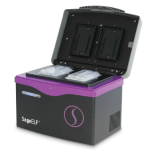
No sooner had we broken down our setup at Ion World than we were assembling our full booth for ASHG’s enormous exhibit hall. This was the first conference where we got to display the newest member of the Sage Science product portfolio, the upcoming Sage ELF (that’s short for Electrophoretic Lateral Fractionator – expect it in January).

This tool can take 12 contiguous fractions of a single sample, making it ideal for clinical and research pipelines running precious samples. It will allow users to prepare multiple libraries from each sample — for example, a long-insert library for PacBio, plus shorter-insert libraries for Ion Torrent or Illumina sequencing — and truly maximize the information that can be gleaned from a single sample.
Much of the excitement at ASHG related to resolving complex genetic structures, with lots of attention paid to the new human reference assembly coming soon from the Genome Reference Consortium. Plenty of large-scale studies were presented during ASHG, often featuring thousands of exomes or hundreds of genomes — confirmation that the field is ramping up to high-powered studies more likely to help determine the genetic root of rare and even common diseases. We are proud to see our technologies are helping in many of these important projects.
Thanks to everyone who stopped by our booths at Ion World and ASHG!